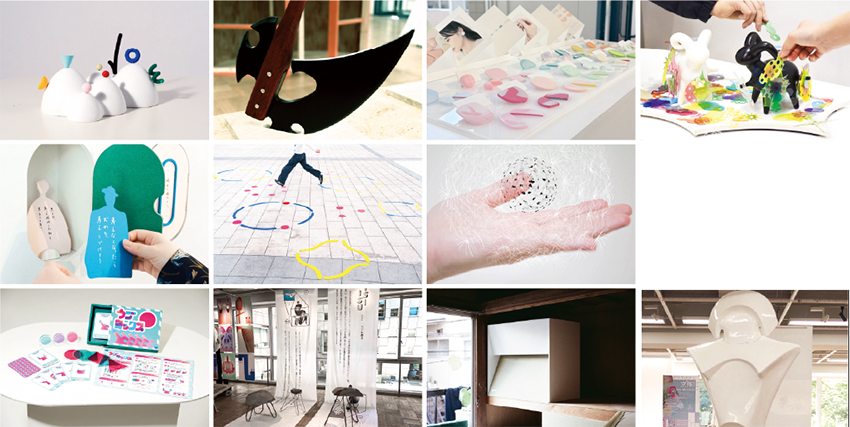
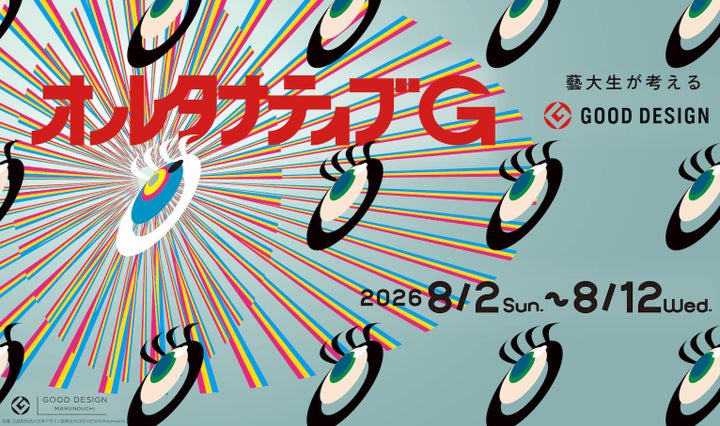
GOOD DESIGN Marunouchi will host "Alternative G: Good Design as Envisioned by Tokyo University of the Arts Students," an exhibition planned by third-year undergraduate students of the Department of Design at Tokyo University of the Arts, from August 2nd Wed Sun to August 12th (Wed), 2026.
This exhibition starts with the question, "What is good design?" and proposes new interpretations of "good" from various perspectives.
Through diverse forms of expression such as products, graphics, video, and spatial design, we re-examine everyday design from various perspectives and explore new values and possibilities. Please come and see the different forms of "good" presented in each work.
─────────────────
Event Overview
─────────────────
#167
Alternative G: Good Design as Envisioned by Tokyo University of the Arts Students
Tokyo University of the Arts, Department of Design, 3rd Year Undergraduate Student Exhibition
Sun, August 2, 2026 -Wed, August 12, 2026
11:00 - 20:00
Open every day during the exhibition period; admission is free.
Co-sponsored by: Department of Design, Faculty of Fine Arts, Tokyo University of the Arts and Japan Institute of Design Promotion
Exhibition URL: https://x.gd/CNPoY
“Alternative G” Good Design Conceived by Geidai Students
An exhibition organized by third-year undergraduate students from the Department of Design, Tokyo University of the Arts
August 2(Sun) - 12(Wed) , 2026
11:00 - 20:00 Free admission
Organized by Japan Institute of Design Promotion, the Department of Design, Tokyo University of the Arts
---------
About this exhibition
"Alternative" means "another option" or "a different way of doing things than before."
This exhibition showcases the results of an assignment given by third-year design students at Tokyo University of the Arts: "Think of alternative good designs."
In today's society, where we are surrounded by an abundance of goods, convenience is excessive, and the pace of change continues to accelerate, what exactly does "GOOD" mean?
They confronted that question, found their own definition of "GOOD" without being bound by existing values, and brought it to life. Please enjoy each of the students' "GOOD" creations, filled with their playful spirit and adventurous spirit.
Keiichiro Fujisaki / Professor, Department of Design, Tokyo University of the Arts
---------
Exhibited works:
"Ugomix"
Haruka Kimura, Milena Kurihara, Maiko Nakata, Rio Yamada
This party game was created based on the feeling of "I'm embarrassed to dance," but "I want to experience the fun of dancing with everyone." By shifting the focus from "dancing" to "enjoying the game," the aim is to lower the psychological barrier to dancing, allowing people to move naturally. Anyone can easily participate and enjoy a sense of unity and rhythm.
'monac.』
Ichika Kamiyama, Yurina Suzuno
We focused on the common occurrence of "losing" or "dropping" something. These earrings can be reused after one is lost by simply breaking the remaining earring once. Inspired by the beauty of the cross-section of Japanese Sweets, breaking them reveals new colors and patterns. These Accessories reframe loss and breakage not as an end, but as a new beginning.
'MOJO』
Akito Aoki Akira Shinmoto Tanchuo
MOJO This is a sound system that reconstructs audio standards, such as speakers, based on the dimensions of a Japanese-style room. Japanese-style rooms have traditional dimensions and a grid created by their repetition, such as shoji screens, pillar divisions, and tatami mats (one mat, half mat). MOJO It is composed of the unique modularity and standards of audio equipment, and the spatial standards of Japanese architecture. MOJO By combining two "standard cultures" with different backgrounds, we designed audio equipment not just as Furniture, but as part of the room itself, as a living space.
'isi isu』
Yutaro Koga, Akiha Fukuhara, Mayu Miyata
By using the heterogeneous material of rock for the seat, and evoking a sense of the body adapting to the environment, the chair challenges the assumptions of "goodness" in homogenized living spaces.
'lologue』
Ayami Yoneda, Anna Kawanishi
Trying to confine emotions to the form of "words" can sometimes diminish their purity. Even those who struggle with writing or find it difficult to maintain consistency can easily and freely capture their daily emotional fluctuations by using intuitive "colors" and "shapes." This new form of record-keeping aims to achieve that.
Picture book
Konomi Inaba
This picture book is not a book for learning about animals by reading text.
This is a picture book for observing creatures that appear in the palm of your hand and sensing their presence.
"Creating Life Through Form"
Kano Nakamura, Ayami Hatsuzaki, Naoko Fukushima
I realized that our lives are enclosed within forms that are organized with meaning and logic. We researched the source of our intuitive comfort with shapes. We traced childhood memories of playing with pockets full of nuts and nicely shaped leaves, and analyzed comfort by sketching freely.
This is an attempt to discover and share forms that directly touch our senses, forms that we are drawn to before we even have a reason to.
"Clay Figurine (1)"
Satoshi Muramatsu
The unique and unusual forms found in clay figurines are thought to have arisen as a result of generations of artists repeatedly creating new figurines based on previously made ones. Through manual errors and subtle changes resulting from individual sensibilities, the forms gradually evolved. By manually recreating the forms of clay figurines unearthed in Yamagata Prefecture, we attempted to restart this process of change that had been interrupted in the past.
"weapon MADE IN JAPAN』
Tomo Nagamai Genta Fukaya
In a world that has achieved peace, how should we confront weapons?
'MOTTO WO ESCORT』
Wang Mengjia, Matsuo Yu
We created a piece called "Motto Escort," which allows you to exchange words one-on-one with an unseen person, based on the theme of the exchange and circulation of "words that someone cherishes" and "words that you cherish." SNS In a world where countless words flow by at a dizzying pace, I feel that we are increasingly treating words as something to be "consumed." On the other hand, I've also realized that there are words that can be a source of comfort or that have stayed with us for a long time, even if they were just casually received. That's why we wanted to create a space where words that have stayed with someone can be passed on to others. We hope that through the experience of encountering someone else's words, the words you receive will become a comforting presence that can be there for you in unexpected moments.
'Difform』
Haruna Asakage, Akari Sugano
A proposal for markers to encourage people to linger in the gaps and empty spaces of a city. A record of its implementation in Ueno Park and Tokyo University of the Arts.